
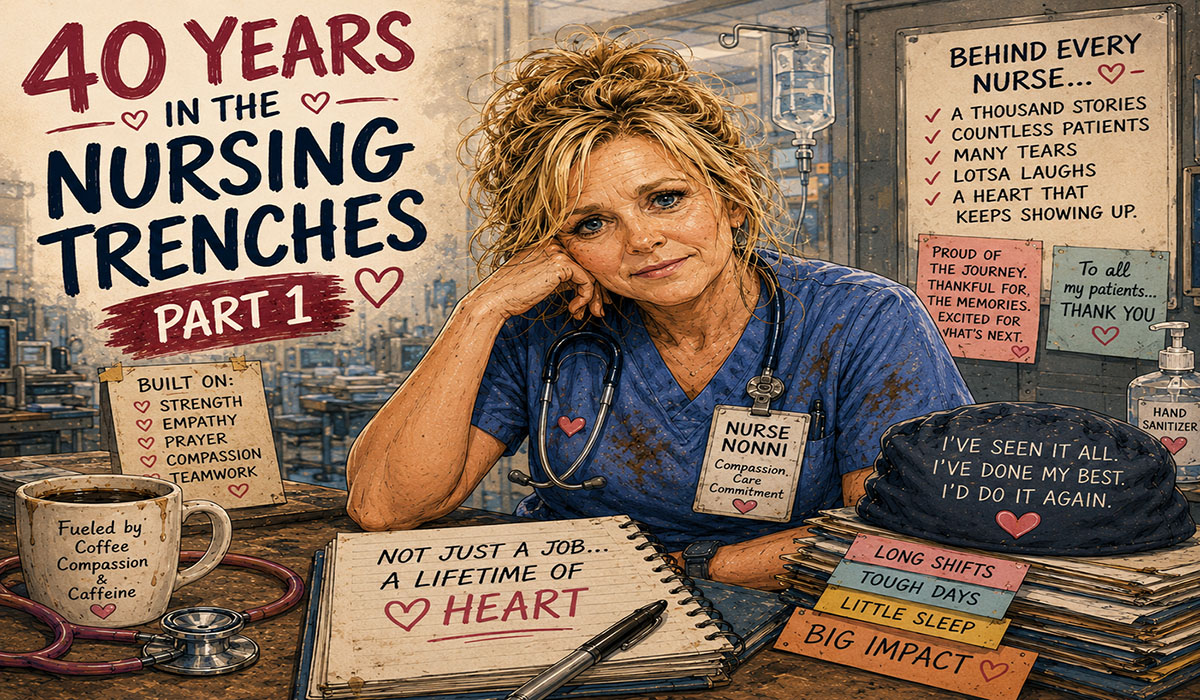
40 Years In The Nursing Trenches – Part I
If I had to sum up my entire 40-year nursing career in one sentence, it would be the opening line from Charles Dickens’ A Tale of Two Cities: “It was the best of times, it was the worst of times.”
Forty years as a registered nurse. I’ve worked in small community hospitals and Level I trauma centers. ER, ICU, CCU. Doctor’s offices. Nursing homes. Private homes. I’ve even worked on a yacht in the middle of the Caribbean.
I’ve cared for patients of every age, color, race, religion, and social class. Rich and poor. Gay, straight, and everything in between. Black, white, and brown. Prisoners and nuns. Ivy League scholars and veterans. CEOs and cashiers. Teachers and truck drivers. Those living in mansions and those who are homeless. I’ve stood in rooms where life began and in rooms where it ended.
I’ve cared for patients battling mental illness, dementia, and chronic disease. I’ve stood beside them as they heard the words no one ever wants to hear: You have cancer. Words that can change a life in seconds. I stood there saying it would be okay, though I wasn’t sure it would be.
I’ve seen unimaginable sadness.
Dead babies. Abused children. Trauma. Car crashes. Falls. Drownings. Head bleeds. Heart attacks. Strokes. Sepsis.
Sometimes they live.
Sometimes they don’t.
I’ve held hands while someone took their last breath. I’ve stood beside families as they received the worst news of their lives. I’ve prayed with patients. I’ve cried with families. And later, I’ve stood alone, whispering the same question: Why, God?
I’ve been hit, spit on, kicked, and had my hair pulled. I’ve been yelled at and called every name imaginable. I’ve been threatened, insulted, and disrespected. I’ve cleaned up every bodily fluid you can think of. Blood. Vomit. Urine. Stool. And sometimes, it’s been on me.
I’ve worked alongside many healthcare professionals. Nurses. Doctors. Techs. Aides. Therapists. Support staff. Not all were kind. Not all were dependable. I’ve worked with laziness. With those who did only the bare minimum. With corner cutting. With blame shifting. I’ve been bullied. Manipulated. Talked about. Used as the punchline.
I’ve gone to work physically sick.
I’ve gone to work emotionally broken.
I’ve gone to work exhausted beyond words.
Sometimes I feel dead inside. I rarely cry anymore. I just feel numb.
I remember my last travel assignment in the ER. There was a house fire. Six family members were inside. A mother. A father. A grandmother. Three children.
The mother and two of the children were already gone.
The grandmother survived. The father arrived in critical condition. We coded him, but he died. The remaining child was severely burned. We coded him over and over again. Bringing him back. Losing him again. Hours later, he was pronounced dead.
It was a horrible shift.
Many of the staff were crying. They brought in extra support to debrief. I sat in the room listening to the charge nurse try to comfort everyone.
I felt nothing.
I didn’t cry. I didn’t fall apart.
I just felt nothing.
I sat there in that moment and thought, What is wrong with me?
Since then, I’ve moved into another type of nursing. Private duty care for high net worth clients. Concierge nursing, you could call it. It’s the perfect job for an old… I mean experienced nurse nearing the end of her career.
I’ve had time to reflect. I’ve thought about that dead-inside feeling a lot. I think many nurses and other healthcare professionals eventually feel it to some degree.
We witness horrific tragedy. Unimaginable grief. Heartbreaking loss. Trauma and death. In the ER, it isn’t rare. It isn’t occasional. It’s every day. Day after day. And within minutes, sometimes seconds, we have to move on to the next patient. And then the next.
These are the worst of times.
I’ve come to believe the only way to survive is to compartmentalize. To push the feelings aside. To store them somewhere safe so you can function.
That numbness. That dead-inside feeling. It isn’t cruelty. It isn’t indifference. It’s survival.
Because if you don’t learn to do that, the grief will overtake you.
It will destroy you.
I’ve been working in private duty for two years now. And slowly, I can feel myself coming back to life.
So why?
Why did I stay in this profession for 40 years?
Why am I still here?
Because through it all, I knew what I did mattered.
I made a difference.
These people needed me.
I looked at the sadness. The trauma. The sickness. And I tried to make it better.
And many times, I did.
We did.
There were hard times. There were heartbreaking times.
But there were also moments of joy, connection, laughter, gratitude, healing. The best of times.
Follow along to Part II –